Showing posts with label 1960s. Show all posts

Friday, July 17, 2015

Night Movies - A Film Noir Watchlist

The following are the 50 films I am planning on viewing for a personal study of the film noir, with an additional 10 others I am planning on rewatching. This study will take place over the last months of 2015. 

I often lose steam with these types of planned viewing efforts, though I am hopeful to follow through this time because this is a genre I have intended to study for some time but have not gotten around to doing any more than a cursory pass on most of the canonical classics. My 50 planned viewings include both accepted genre classics and underrated tertiary noirs that deserve more love and attention. 

While I am still getting my head around the genre itself, I know one unique focus I will be taking with these films is a particularly keen interest in the geography, location photography, and urban settings of these films. Invigorated by the geographic explorations and investigations of Thom Andersen’s Los Angeles Plays Itself (2003), I am curious to see how many of these films deal with their geographical setting and in what ways the story and locations are tied together. 

I am a bit of a geography nut, so this type of approach is really fascinating to me. Noir strikes me as one of the early genres that more consistently gets out of the studio into the world of urban location shooting (often Los Angeles, considering the ease of proximity), so I am very curious to see what how that technical changes affects the films being made. Many of the films I have chosen to view were planned with this thesis in mind. 


50 Films Noir to View
711 Ocean Drive (Joseph M. Newman, 1950)
Angel’s Flight (Raymond Nassour & K.W. Richardson, 1965)
Armored Car Robbery (Richard Fleischer, 1950) 
Autumn Leaves (Robert Aldrich, 1956) 
Beware, My Lovely (Harry Horner, 1952) 
The Big Heat (Fritz Lang, 1953)
The Big Knife (Robert Aldrich, 1955) DVD
The Bigamist (Ida Lupino, 1953)
Blast of Silence (Allen Baron, 1961)
Body and Soul (Robert Rossen, 1947)
Boomerang! (Elia Kazan, 1947)
Border Incident (Anthony Mann, 1949)
Brighton Rock (John Boulting, 1947)
Caged (John Cromwell, 1950)
Call Northside 777 (Henry Hathaway, 1948)
Cape Fear (J. Lee Thompson, 1962)
The Chase (Arthur Ripley, 1946)
Crime Wave (André de Toth, 1954)
The Crimson Kimono (Samuel Fuller, 1959)
Criss Cross (Robert Siodmak, 1949)
D.O.A. (Rudolph Maté, 1950)
Detective Story (William Wyler, 1950)
Edge of Doom (Mark Robson, 1950)
Gilda (Charles Vidor, 1946)
Gun Crazy (Joseph H. Lewis, 1950)
The Hitch-Hiker (Ida Lupino, 1953)
Kansas City Confidential (Phil Karlson, 1952)
The Killers (Don Siegel, 1964)
Lady in the Lake (Robert Montgomery, 1947)
Leave Her to Heaven (John M. Stahl, 1945)
M (Joseph Losey, 1951)
Mildred Pierce (Michael Curtiz, 1945)
The Money Trap (Burt Kennedy, 1965)
Nightmare Alley (Edmund Goulding, 1947)
Odd Man Out (Carol Reed, 1947)
The Phenix City Story (Phil Karlson, 1955)
The Postman Always Rings Twice (Tay Garnett, 1946)
Reign of Terror (Anthony Mann, 1949)
Ride the Pink Horse (Robert Montgomery, 1947)
Riff-Raff (Ted Tetzlaff, 1947)
Rififi (Jules Dassin, 1955)
Scarlet Street (Fritz Lang, 1945)
Side Street (Anthony Mann, 1949)
Somewhere in the Night (Joseph L. Mankiewicz, 1946)
The Strange Love of Martha Ivers (Lewis Milestone, 1946)
The Tall Target (Anthony Mann, 1951)
They Made Me a Fugitive (Alberto Cavalcanti, 1947)
Tomorrow Is Another Day (Felix E. Feist, 1951)
Underworld U.S.A. (Samuel Fuller, 1961)
Union Station (Rudolph Maté, 1950)
The Window (Ted Tetzlaff, 1949)

Ten Overdue Rewatches
Double Indemnity (Billy Wilder, 1944)
Fallen Angel (Otto Preminger, 1945)
The Lady from Shanghai (Orson Welles, 1947)
The Killers (Robert Siodmak, 1946)
Kiss Me Deadly (Robert Aldrich, 1955)
Out of the Past (Jacques Tourneur, 1947)
Raw Deal (Anthony Mann, 1948)
T-Men (Anthony Mann, 1947)
Thieves Highway (Jules Dassin, 1949)
Whirlpool (Otto Preminger, 1949)

Thursday, June 13, 2013

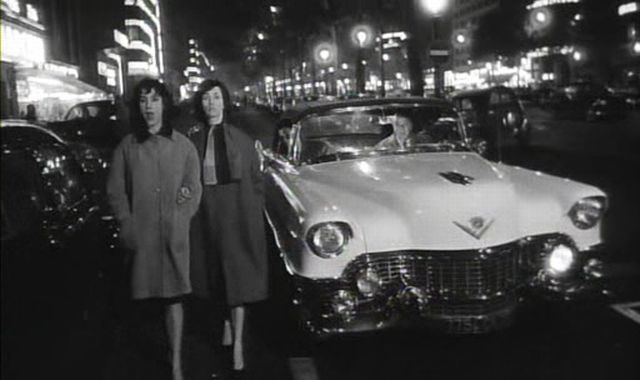
The Death of Romanticism in 'Les Bonnes Femmes' (1960)

Les Bonnes Femmes (Claude Chabrol, 1960)
Swinging the pendulum deftly between various moods -- documentary-like observation, gender comedy, absurd comedy, tragedy and finally, quiet transcendence -- Chabrol's film shows a careful narrative structure and a formal beauty that really gripped me.  This is my first Chabrol film and I come to it already familiar, though not overly enamored, with the other early touchstones of the French New Wave: The 400 Blows (Francois Truffaut, 1959) and Breathless (Jean-Luc Godard, 1960).  This is a really beautiful and unique film that is made so rich mostly because Chabrol's keen interest in human interaction, spoken and unspoken.

A delicate portrait of city women and a searing subversion of romanticism, Chabrol follows four Parisian girls in their early 20's over the course of a handful of days and nights, though it is the stories of Jane and Jacqueline that get the lion's share of the focus.  Both of these women are intensely romantic, though in opposite ways.  Jane embraces the romanticism of choice, freedom, being unencumbered, being her own woman; Jacqueline embraces the more conventional romanticism of being swept off her feet by a man who loves her deeply.  Over the course of the film, their romantic notions will be thwarted as the men who drift through their lives upend their dreams of freedom and love.

Jacqueline and Jane are walking home one evening when they are suddenly stalked very persistently by the ostentatiously lighthearted duo of Marcel and Albert.  They are nothing more than guys looking for a good time and though they seem charming and entertaining early on, over the course of the evening they become increasingly callous and demanding of Jane, who is far more accommodating than Jacqueline.  Eventually, she is in their apartment and expected to be sexually involved with both men.  Chabrol, though ultimately sympathetic to the women who are at the mercy of men in power, still sees a paradoxical conflict where Jane's own freedom of choice has brought her to this compromised state.  When Jane returns to her apartment early the next morning, we get the unfortunate feeling that she had to involuntarily give into at least some of the men's demands.  She is not in the mood to discuss with her roommate anything that happened. 

One of the key scenes is the night at the swimming pool, a scene where every major character (apart from Mr. Balin) is present.  It starts as a lighthearted jaunt that slowly turns into a aggressive assault of masculine dominance in its good and bad forms.  Marcel and Albert happen to be at the pool too, where Jane, Jacqueline and the rest are enjoying their evening.  The two men quickly start teasing Jane into introducing them to their party and find that she has become significantly less accommodating since the last time she was with them.  Quickly, things deviate into a prankish show of disapproval, where Marcel and Albert throw all the others into the pool and start dunking them all under water.  Jane and Jacqueline obviously get the brunt of the dunking in what has quickly shifted from good-natured prank into psychological torture.  Chabrol notes this shift in tone by shifting his camera angle, showing us underwater shots of Jacqueline being pushed under, matched with muffled underwater audio. Finally, we get our relief in the form of Andre, who dives in from the high dive to swim over and rescue Jacqueline from her peril.  The two men, now emasculated and embarrassed, back off as Andre becomes the hero of the scene and the wish fulfillment of Jacqueline, who has noticed him stalking her recently.  

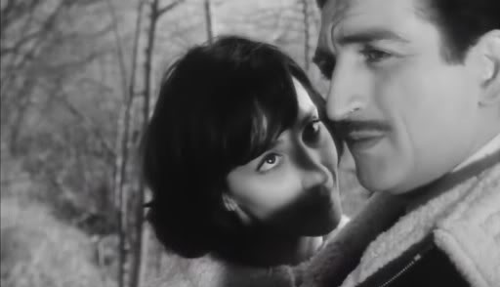
At this point, it seems Chabrol has brought us full-circle into a traditional (though slightly unconventional) romantic film, as Andre and Jacqueline are quickly away into the countryside, sharing a meal together where Andre proves himself to be a jokester himself, full of little tricks that amuse the enamored girl.  He takes them on a walk in the woods that slowly becomes more and more uncomfortable, until finally we are given an ambiguous moment of consummation, as the two lay together in an isolated area as the birds around them call out rhythmically.  Chabrol finally lets us in on what is happening (having alluded to it so obviously earlier with Andre's own inquisition -- though as a hopeful optimistic, I disregarded it) as we see that Andre is strangling Jacqueline, whose squirms were not the happy writhing of passion but the desperate movements of anguish.  

Andre leaves the scene quite hurriedly and we are never afforded an answer to his mystery.  Why was he following her?  Why did he want to kill her?  Did he know anything about her at all?  Instead, Chabrol takes us into a dance hall where a young woman is being asked to dance by a young man.  We cannot see the man's face because we are left with the gaze of the young woman, who literally locks eyes with us and is intercut with the slowly changing angle of the glistening mirror ball above them.  The metaphorical fractured beauty of the ball is now a frustrated thing, not giving us narrative or sentimental satisfaction, but a vignetted series of dots that clutter the atmosphere and highlight how bright the light could be if it were just focused.  The romanticism that seemed so certain only ten minutes prior has now been unfairly shattered, and we are left with a moment to ponder the frustrating reversal as we experienced the fulfillment of our greatest fears rather than our greatest dreams.  It is a strange moment of transcendence.


Saturday, November 19, 2011

Pierrot le fou (1965)

Pierrot le fou (Jean-Luc Godard, 1965)
A few things I learned/observed in Godard's tenth feature film...

A man and a woman engage in an affair in which they embrace modernity and violence while neglecting the conveniences of modern living for the principles of revolution.

The landscape is scarred by text.

Sometimes cinema is montage.  Editing can find realities that cannot exist alone in an image but do exist through juxtaposition.

Blocking actors in space does not have to be a humorless affair.

In the silent era, a shot like this would be cropped in-camera.  In modernity, it is cropped via architecture.

Absurdity is important.