Showing posts with label 1971. Show all posts

Thursday, July 4, 2013

The Big Mess (1971)

The Big Mess (Alexander Kluge, 1971)
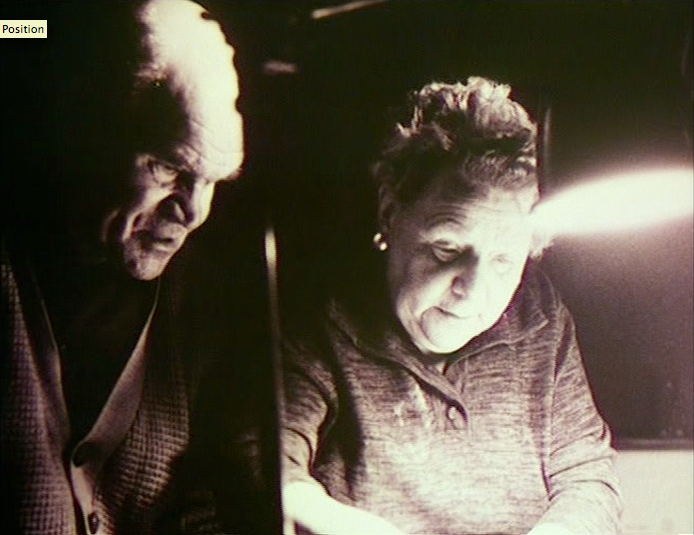
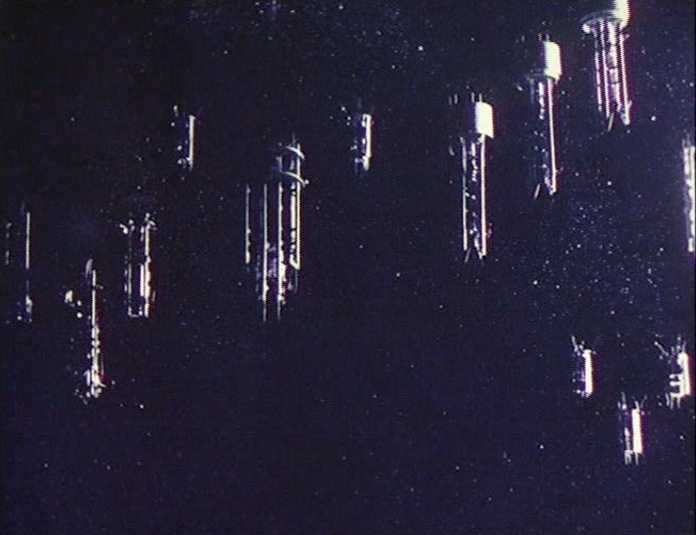
An aptly-named, hyper-collage, hyper-conceptual satire on capitalistic expansion, Kluge’s film feels like a strange d.a. levy poem about space travel written on a wall in a gas station bathroom.  One’s ability to enjoy this film is directly related to one’s ability/willingness to follow the conceptual tangents Kluge is weaving throughout.  Particularly of note are the themes of industrial monopoly and industrial scrap.  Considering that the special effects in the movie are basically appropriated pieces of trash, Kluge is painting the great cosmic expansion as a pursuit where the largest companies are making insanely massive, state-of-the-art spaceships that are simply floating scrap ready to be bought and refurbished into new floating pieces of scrap not long after being launched.  None of it seems to matter to the companies so long as they maintain control.  
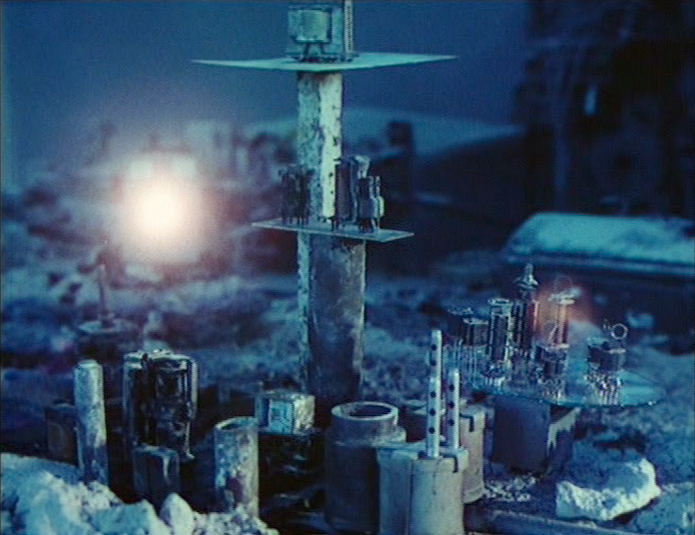
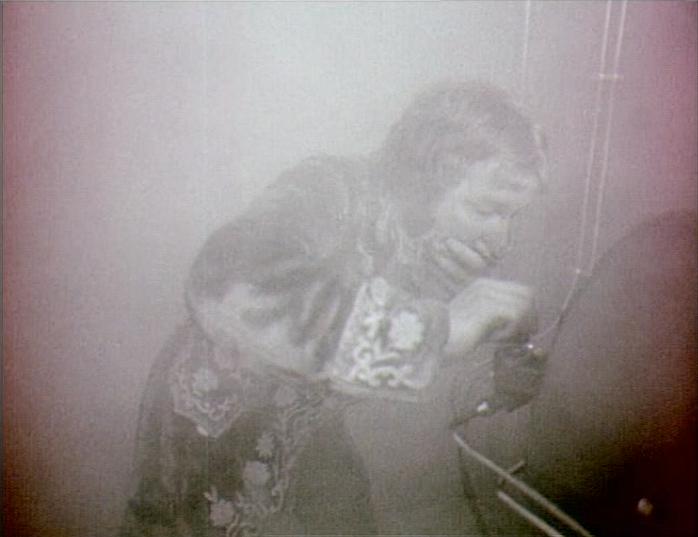
Many of Kluge's effects have been cheaply rendered, though not without considerable time, effort and imagination.  But his appropriated trash also conceptually serves his thematic interests.
The two accumulators go through their budget.  Even though they act as the system acts they do not have the system's permission to act that way and thereby are a threat to the system. 
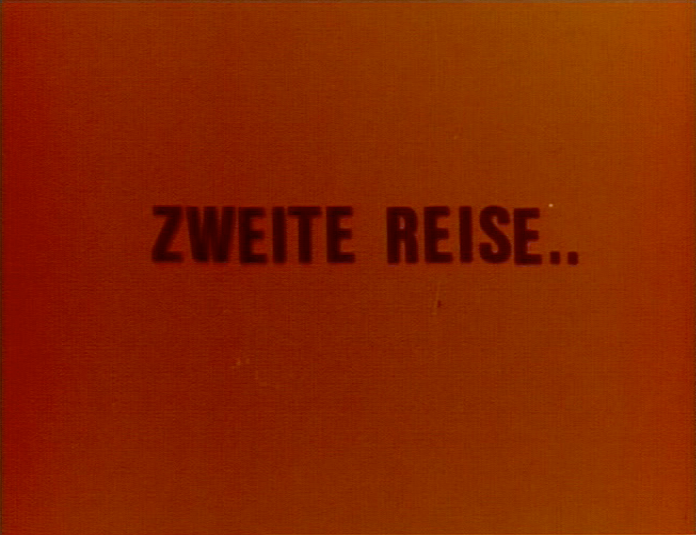
"Second Voyage.."  Kluge utilizes a slew of title card to give narration, some of it narrative, some of it atmospheric (such as some definitions from a Galactic Textbook).  All of it serves his style of collage.  There is no consistency in the color, layout or typeface used between cards, adding the the disorienting and chaotic affect of a disorienting and chaotic future world.

There is a bullying of the private accumulators, who basically do the same thing the large companies do but without their permission (and since the companies own everything, the accumulators are de facto thieves).  Despite the variety of faces that make an appearance in the movie, it is the Suez Canal Company that is the main throughline.  As a viewing experience, it is heavily fractured, a bombarding of words and ideas loosely linked to more traditional narrative images.  It is hard to see the connections sometimes but I think it is the force and speed with which it shifts between tones and storylines that is part of Kluge’s purpose.  Technological advancement is seen as a hodge-podge of old, antiquated notions repurposed and new ideas barely cultivated all quickly cobbled together to serve the capitalistic interests of the ones controlling the galaxy.  

The irony for Kluge is that his movie is like the accumulators in the film: charming and imaginative but ultimately doomed because the galaxy is already owned by the big boys.


Thursday, April 11, 2013

Two-Lane Blacktop (1971)

Two-Lane Blacktop (Monte Hellman, 1971)
Does this film really exist?
Where is the pride, the pretense, the artificiality?
First dialogue is 6 minutes in.
The success is two-fold: silence and ellipses.
The silence comprises a major part of the film.
Action or non-action -- the background is usually moving.
Dialogue is sparse yet conversational.  Not overly stylized.

There is an openness, a willingness to let action and decisions take place off-screen.  
Conversely, thoughts and indecision happen on-screen.

When the Girl arrives, she simply gets in the car.
No scene is made because the characters honestly do not care.  
They will take her along.  Sure.  Why not?
When she leaves, she simply up and leaves.  
Independent.  Unbounded.  The open road.

Warren Oates embodies a real person we see in parts.
A lying iceberg who must talk continually.
If he stops talking, he dies.
Sweaters.  Gloves.  Lilted smile.
Show me a better character in American cinema.

The allowance is for the audience.  Watch and listen.
Play along.  Follow the lines.  Embrace the characters.

This land is our land, every corner of it.
The widescreen mirrors the landscape.  
We see the whole thing.

film journal entry: 07.09.2012